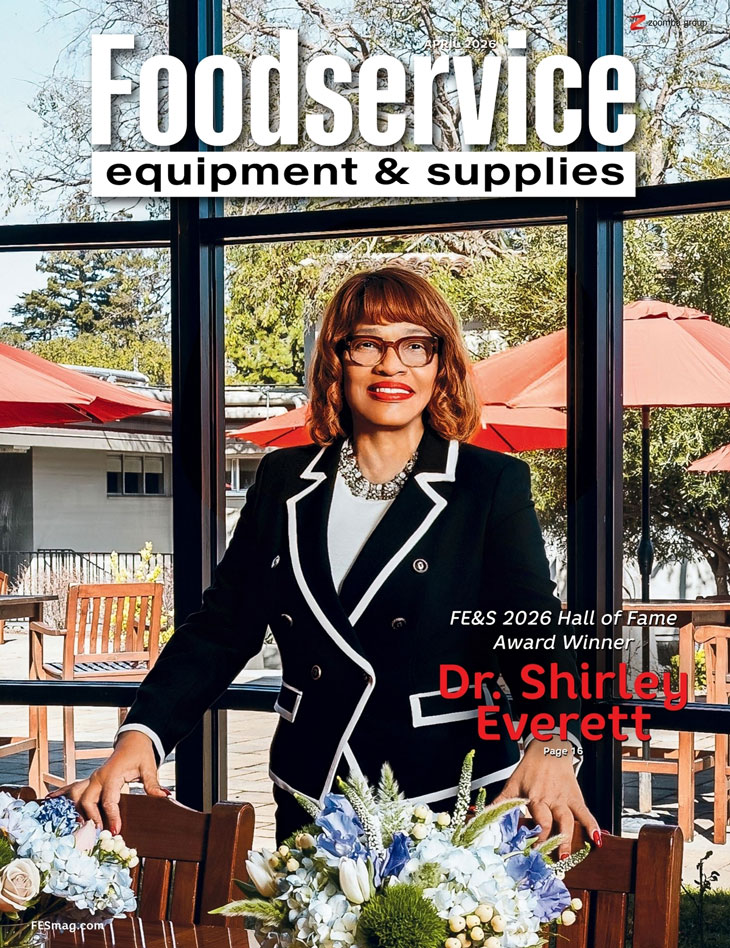
For many years, higher-education foodservice was seen as a means to an end. The food prepared for students often was regarded as simply fuel, with taste and creativity playing small parts in the overall equation. The 2026 FE&S Hall of Fame Award winner has spent her entire career devoted to changing that through collaboration, compassion and a deeply rooted belief that everyone’s voice matters — from dishwashers to chefs and, yes, the students. The end results have been nothing short of revolutionary.
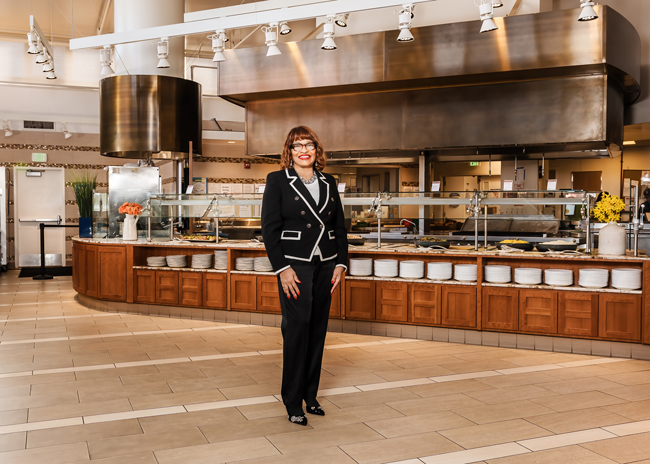 Photography by Carolyn FongFrom the beginning of her nearly 35 years at Stanford University, Dr. Shirley Everett has strived to transform and reimagine the dining experience at the prestigious university. Her journey has been steadfast with a culture of excellence and a one-team mindset guiding her every step.
“My vision was to create, curate and innovate in this space because I wanted to make a meaningful difference in the lives of others,” says Dr. Everett. “Food is a profound sensory experience that engages all five senses, serving as a bridge to foster dialogue, build community and enable us to embrace diverse cultures over shared meals. By focusing on the intersection of culinary excellence and human connection, I saw an opportunity to have a lasting impact on the student experience and the broader university community.”
Starting with her first role at Stanford in 1991 as executive director of Stanford Dining to her current role as senior associate vice provost for Residential & Dining Enterprises (R&DE), Dr. Everett has created programs and initiatives whose impact can be felt not just at the school she has called home for nearly three-and-a-half decades but in the higher education foodservice community as a whole. As co-founder of the Menus of Change University Research Collaborative (MCURC), in partnership with the Culinary Institute of America, she has helped develop groundbreaking strategies that motivate students and consumers toward healthier, more sustainable, plant-forward diets within universities and beyond. Today, she stewards a $3 billion portfolio and leads eight integrated divisions at Stanford. R&DE is an enterprise that houses 16,000 students and serves 8 million meals annually, all while maintaining a steadfast commitment to fiscal stewardship and service excellence.
Personal Pathway
While her accomplishments are many, Dr. Everett’s path to get where she is today wasn’t without obstacles. She recalls her experience as a student at Valparaiso University in Indiana as intellectually rewarding but also fraught with the harsh realities of hate and racism, personally witnessing a cross burning and men in white robes near campus. But she didn’t let these heinous acts discourage her.
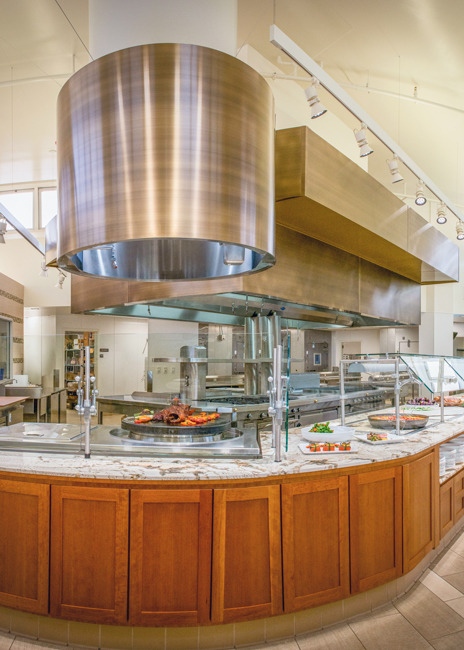 The renovation of the kitchen and servery at Florence Moore Hall were completed during the summer of 2013.“They afforded me the opportunity to grow and learn how to navigate intense adversity with grace and grit,” she says. “The silver lining is that I discovered my own strength. If I hadn’t walked through that fire, I wouldn’t know the depth of my own ability to lead with compassion and inclusive excellence. I chose to channel those experiences into a purposeful fuel, igniting my vision to create communities where everyone, regardless of background, feels a true sense of belonging.”
Her resilience started at a young age. “My parents believed that when you encounter a mountain, strive intently to climb over it, around it or through it and never let it deter your plan to master the mountain to get to the other side,” she says. “They encouraged us [her and her seven siblings] not to use race or racism as barriers, but fuel as motivation to achieve our dreams.”
Dr. Everett’s journey into the hospitality industry began at the age of 10, when she had to step in for her mother who was ill and lead her siblings in preparing the family Thanksgiving meal. She majored in home economics at Valparaiso University, and from there, she transitioned into higher education dining first at Bryn Mawr College and then at the University of Pennsylvania, before moving to California to serve as the assistant director of dining at UC Berkeley. Next, she joined Stanford University as the executive director of Stanford Dining — and never looked back.
When she first arrived at Stanford, its foodservice program looked a lot different than it does today. “We were cooking many food items that were unrecognizable,” says Dr. Everett. She recalls meat proteins smothered with gravy and writing on food shields to identify them. Dietitians wore white coats and hairnets. “It looked more like a chemistry lab than a dining hall,” she says. She knew there had to be a better way.
After an initial assessment, she decided a total transformation was needed. Dr. Everett also saw the potential to do more than just provide a service. “My focus was on renovating our operations and elevating the culinary experience to match the university’s academic excellence,” she says. “I was deeply inspired by the university’s mission of research and education, but I also recognized a significant opportunity for innovation within the campus dining program.”
Language became a starting point. “We began by reframing our identity, transitioning from foodservice to a true dining and hospitality model and elevating roles from cook to ‘chef’ and dietitian to ‘nutritionist,’” she says. Next up was a modernization of the student dining experience. That meant moving away from the traditional cafeteria model and creating dynamic, inviting atmospheres where students could foster community. The front-of-the-house area saw innovations as well with the introduction of exhibition cooking and open-kitchen formats, making transparency, engagement and fresh, delicious and nutritious meals pivotal to the experience.
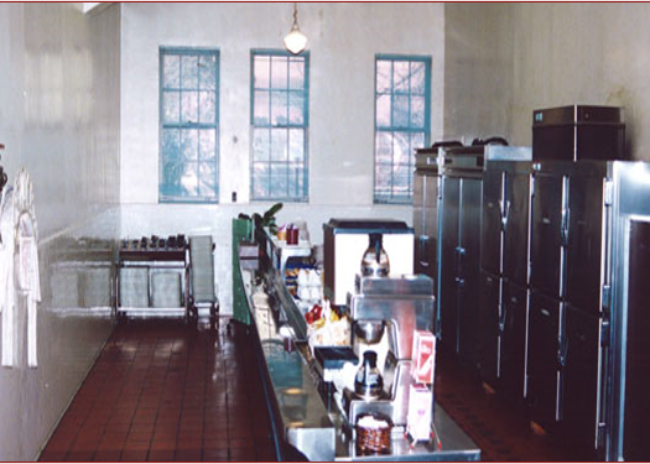 Branner Dining Hall before the renovation.
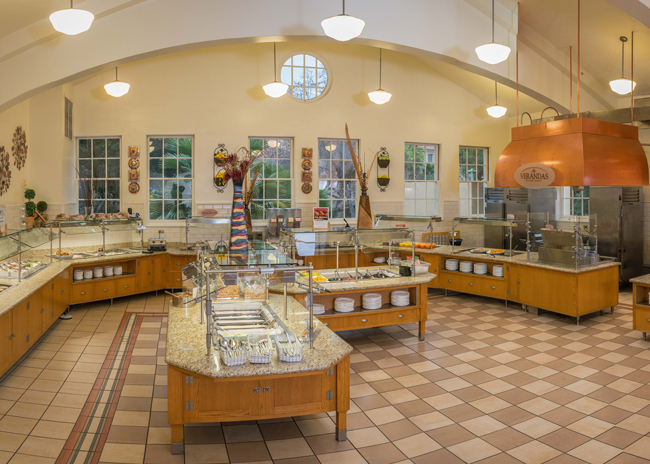 Branner Dining Hall after 2005.
Transforming the Mindset
In 2001, when she was promoted to associate vice provost, Dr. Everett saw an opportunity to make a difference beyond dining operations. “I wanted to transform our organizational mindset,” she says. That was the beginning of her “culture of excellence” approach that would serve as the heartbeat of everything she and her team did and continue to do across student dining/hospitality, housing, maintenance operations, asset renewal, capital planning and design.
“Having the resources and the institutional support to build something from the ground up allowed me to turn that vision into a reality,” says Dr. Everett. “That ensured that our housing and dining operations were not just functional, but foundational to the living and learning environment of this premier institution.”
Stanford alum Jocelyn Breeland, now chief communications and marketing officer for R&DE, remembers what student housing and dining were like before Dr. Everett arrived. “To say she has transformed the student experience is no exaggeration,” Breeland says. “Now, as a member of her senior staff, I understand that all the positive changes come from clear vision, leadership, and the ability to nurture and develop staff.”
Dr. Everett describes her philosophy of culture of excellence as a shared sense of purpose that empowers every team member to deliver excellence. Aiding in that approach is her idea of a “one-team mindset.” “That is where every member of the team is valued, regardless of their title,” says Dr. Everett. “The truth is our executive chefs can only achieve culinary excellence if our dish room team delivers clean pots, and our maintenance technicians ensure our equipment is safe and reliable. We are only as strong as our weakest link, and it takes every person playing their role in a highly effective manner for us to succeed.”
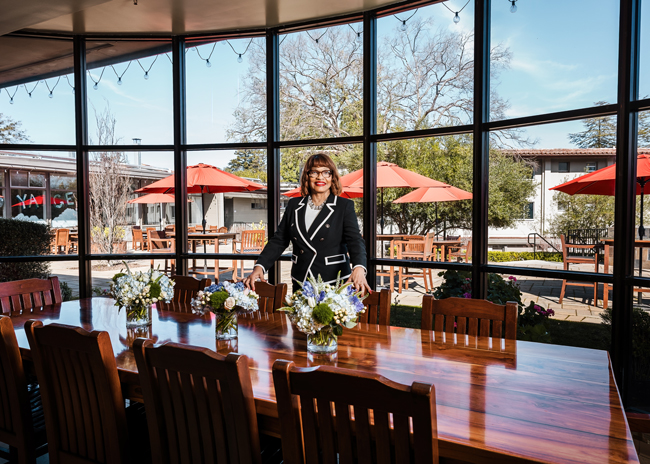 Providing her team with the necessary tools and resources is a big part of investing in their professional and personal growth. That includes senior leadership retreats, the annual All-Hands meeting and signature development programs such as Stepping Stones to Success, Women’s Leadership Development Program and Women’s Leadership Summit. “When leaders don’t allow people to feel like they matter, productivity slows down, toxicity moves in and turnover happens,” she says of her inclusive excellence mantra.
Proof that these initiatives work comes via the number of employees who have been at Stanford for 15-plus years. “Our team members are long-tenured,” says Dr. Everett. “Just recently we had an employee reach their 50th year anniversary.”
That focus on employees begins even before they are part of the Stanford team. “When hiring, one of the most important moments is when you put your bias in check,” she says, adding that having bias is part of being human. “I find when I hire people who don’t always look or think like me but have passion for excellence, that’s a great hire. I can share something with them, and they are going to be able to give me feedback.”
She admits that she might not always agree with them but providing an environment where everyone feels safe to express themselves is vital. “My goal is to provide an outlet for all my staff to feel valued. I know personally what it’s like to feel like you’re not included. I don’t want other people to experience that.”
Meeting people where they are is the approach Dr. Everett always takes. “We are more alike than different, and somewhere we’ve been taught that we are not,” she says. “I want to continue to advance the work so our students, faculty and staff can help build a new frontier where we work together so folks historically underserved have a voice and add to their organization. That makes a better world for all of us.”
Robert Coles, Stanford’s senior director of creative and digital services, strategic communications and marketing, R&DE, vividly recalls meeting Dr. Everett back during his job interview in 2018. “We sat in her office for what was scheduled to be a brief meeting, but the conversation extended well over an hour,” he says. “It was not transactional. It was expansive. Even in that first encounter, I knew I was sitting with someone of extraordinary vision, conviction and depth. She spoke not only about operations, but about people, culture and possibility.”
Adds Thomas Walters, director of administrative programs at Stanford, “She has long believed that people are our greatest asset by setting high standards, hiring talented staff, training at all levels and ensuring there is opportunity to thrive and advance.”
Then, of course, there are the students. “I have always shared with my team that students are never an interruption in our day; they are the reason we are here,” says Dr. Everett, referencing her “students first” mantra. She sees food as a way for Stanford students — who come from all over the world — to feel at home. Cultural activities around holidays spotlight dishes of the countries being celebrated. “Food allows for conversations and the breaking down of gaps in communication,” she says. “We can sit across from each other and if we have nothing else to talk about, we can talk about food and how it impacts our lives. It allows for deeper conversations.”
A Collaborative Approach
Working with others, often those outside of the traditional world of higher education, is common for Dr. Everett, who isn’t afraid to ask for input to achieve her goals. Take, for instance, Menus of Change University Research Collaborative, which she co-founded alongside Eric Montell, assistant vice provost for R&DE Stanford dining, hospitality & auxiliaries; Greg Drescher of the Culinary Institute of America (CIA) and Dr. Christopher Gardner from the Stanford School of Medicine. What began as a visionary partnership has grown into a global network of more than 80 colleges and universities.
“Our mission is to use campus dining as living laboratories where we can accelerate the adoption of healthier, more sustainable and delicious foods, all grounded in rigorous evidence,” says Dr. Everett. “We have built a robust research pipeline that focuses on plant-forward diets, food waste reduction and the drivers of consumer behavior.”
While the shared goal of Stanford and the CIA is ambitious — to reduce food-related greenhouse gas emissions by 25% by 2030 — by leveraging their combined purchasing power and shared commitment to innovation, they are proving that operational excellence and environmental stewardship go hand in hand.
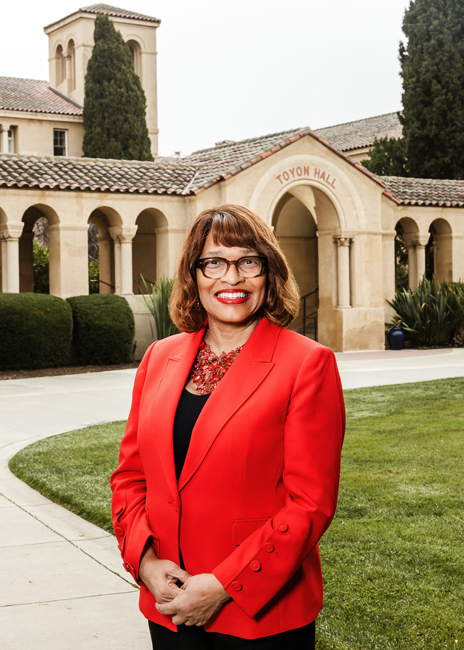 “For nearly three decades, I have had the privilege of working alongside Shirley at Stanford, witnessing her transform Residential & Dining Enterprises into one of the most respected collegiate organizations in the nation,” says Montell. “Her leadership is both highly strategic and deeply personal. Shirley’s impact extends well beyond Stanford through national organizations, industry partnerships and the extraordinary leaders she has cultivated throughout her distinguished career.”
Rafi Taherian, senior consultant, Brailsford & Dunlavey and retired associate vice president Yale Hospitality, Yale University, first met Dr. Everett in the summer of 1996 at the CIA campus in St. Helena, Calif. She had engaged the CIA to design and deliver a series of culinary and gastronomic training sessions for the Stanford Dining team. “An approach that, at the time, was truly ahead of its era,” he says.
What struck Taherian at that time was Dr. Everett’s intent with regards to training. “She wasn’t pursuing training as a ‘perk’ or a one-off program. She was building capability — developing chefs and operators as leaders —because she believed campus dining could and should be transformed. Shirley understood that if you want to change outcomes, you have to invest in people and systems, not just in ideas.”
Taherian describes Dr. Everett as a pioneer in immersive culinary training. “She believed campus dining had to be transformed — and that vision alone wouldn’t make that happen. She wanted chefs and operators fully equipped to build that future with her,” he says. “During my tenure at Stanford, learning and professional development were not occasional — they were part of the culture, supported both internally and through outside opportunities.” He credits her with elevating foodservice from a “support service” to a strategic, student-centered enterprise — operationally excellent and culturally meaningful.
Mary Molt, Ph.D., R.D., L.D., associate director/assistant professor at Kansas State University, met Dr. Everett early in their mutual foodservice careers. “Shirley has influenced me most through the way she leads, with deep respect for her team, steadfast loyalty and a shared commitment to excellence that everyone around her feels,” she says. “I’m equally moved by the Stanford team’s generosity under her leadership, consistently offering their time, insight and often their resources to support other foodservice professionals.”
While Dr. Everett’s primary role is serving as the senior associate vice provost for R&DE, she is involved in many other areas at Stanford, including special advisor to the provost and chair of the Stanford Federal Credit Union board of directors. She is also a member of the President’s Full Cabinet, and serves on several key steering committees, including the Ethics, Enterprise Risk Management and Compliance Committee, the Public Health and Emergency Management Steering Committees, and the Climate Action Executive Group. “Collectively, these roles provide me with a 360-degree view of student needs, operational risks and long-term stewardship,” she says. “There is never a dull moment.”
“Her leadership reflects intellectual rigor and a deep commitment to justice-centered principles,” says Coles. “Both steady and forward-moving, she challenges systems while simultaneously strengthening the institutions she leads.”
“She’s paved the way for so many women, people of color and quite simply all individuals across the foodservice and hospitality landscape to break perceived or actual barriers and collectively to raise the bar for what we can achieve as a community of hospitality and foodservice professionals,” says Stephanie Gilbert, chief commercial officer at Food Service Holdings, who got her career start at Stanford under the guidance of Dr. Everett. “Her impact has and continues to have an indelible impact on our industry.”
Dr. Everett’s leadership has been instrumental in the design and planning of several landmark projects, including the award-winning Arrillaga Family Dining Commons, a flagship facility celebrated for its innovative design, programming and culinary excellence. The Escondido Village Graduate Residences, a $1.1 billion, 2,400-bed complex, stands as the single largest construction project in Stanford’s history, even more remarkable as it opened during the height of the pandemic. On a personal level, Dr. Everett is proud of completing her Doctorate in Educational Leadership while leading R&DE.
“It would be impossible to measure Dr. Everett’s ongoing legacy and her impact on the lives of countless students, staff and faculty over her nearly 35 years of service and the ripple effect it has produced around the globe,” says Domingo Carlos, assistant director of administrative services at Stanford. “She leads with heart and compassion, yet with astute business acumen. She carries herself with poise, humility, and demonstrates courage like no one else when the challenge arises. When she speaks, everyone listens.”
Mentoring has been an enduring signature of Dr. Everett’s time at Stanford. “People are our greatest assets,” she says. “If we want to be the best in the business, we must invest in our people by attracting, developing, rewarding and retaining a diverse workforce and creating pathways for advancement.”
“From the genesis of my career, she and her team took a chance on a young, inexperienced, yet passionate recent graduate and built the foundational elements and groundwork for how I work, manage and lead to this very day,” says Gilbert.
David Ward, assistant vice provost for R&DE Student Housing Operations and Stanford Conferences, knows Dr. Everett’s thoughtful mentorship first-hand. “Dr. Everett has invested in my personal and professional growth ever since I arrived on campus,” he says. “Beginning with my first interview with her for the first position I assumed on campus, she has always challenged me to think about the big picture while also honoring and respecting important details.”
“In my journey as a leader, I often find myself in rooms where very few people look like me,” says Dr. Everett. “In those moments, the challenge is not just to occupy a seat at the table, but to represent the voices of the team I lead and the students and campus community I serve. Looking back at the difficult terrain I navigated, I’ve learned that it is possible to not only reach the summit of one’s professional goals but to truly enjoy the journey while pursuing your passions.”