It’s early at the World Bank Group’s Washington, D.C., headquarters, and the day is already in motion — meetings stacking, deadlines tightening, visitors arriving in waves. Down in dining, the work is equally time-sensitive: equipment checks, deliveries staged, stations calibrated, teams moving into position. In a place where time is currency, foodservice is part of the institution’s infrastructure.
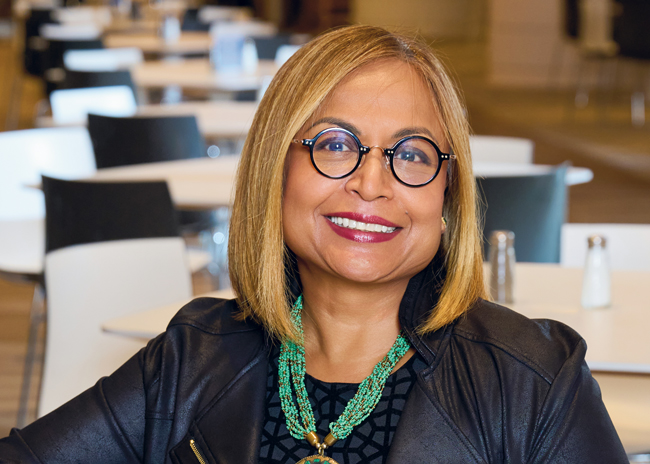 Sharon Eliatamby, World Bank, senior program manager, Washington, D.C.That’s the terrain Sharon Eliatamby manages every day. She is the senior program manager for Dining and Food Services at the World Bank, also providing operational support to country offices. Her work revolves around maintaining service quality, compliance, cost-efficiency at scale, driven by high professional standards and for a dedicated workforce who brings the world to the table.
“The job is always evolving,” Eliatamby says. “We’re spending more time nowadays looking at the strategic plan holistically — what foodservice will look like in the future, how to make it more efficient and control costs — rather than day-to-day operations.”
A First Test
Eliatamby’s career didn’t begin with a grand plan. It began with a tray, a crowded room, and the kind of pressure that arrives without announcement. At 17, she landed her job as a banquet server and on her first day served hot chocolate to Malaysia’s prime minister.
“I didn’t spill it, and he gave me a big smile,” she recalls.
In service, the smallest error can be the loudest. Eliatamby learned early that calm is not a personality trait; it’s a professional skill. Born and raised in Malaysia, like many Malaysians, she is of mixed background, with a mother of Chinese/Thai ethnicity and a father with Sri Lankan origins.
From Malaysia, Eliatamby left home for training and an internship at the César Ritz Institute in Switzerland, drawn to a place where standards are structural and systems are nonnegotiable.
Eliatamby moved to Providence, R.I., to complete her studies at Johnson & Wales University, and the cultural shift hit hard. “In the U.S., it felt like sink or swim,” she says. “You have to work hard to get recognized.” That mindset — earn it, prove it, repeat it — set the tone for what came next: contract management, turnaround work, and larger rooms with higher expectations.
Eliatamby took an internship with Gardner Merchant in London, moving into business and industry operations — law firms, school systems, hospitals — places where budgets are unforgiving and consistency is the product. That path eventually brought her to Washington, D.C., including oversight of foodservice at World Bank. She spent two years there, then worked for other demanding accounts in the region.
“They trusted me to streamline policies and rebuild accounting procedures — work that improved controls and strengthened the client’s financial performance,” Eliatamby says. Fixers live in the unglamorous layer of leadership: the part that sees the mess, names it, and corrects it with controls, staffing clarity, and repeatable process.
One of Eliatamby’s most revealing career moves came from a simple question: Why wasn’t her company being used to cater major events? She didn’t accept the “that’s not how it’s done” answer. She went to learn it firsthand.
“So I went undercover,” Eliatamby says. “I got an evening job as a waiter at the Ronald Reagan Building, just to see how it was done.” She brought those insights back, persuaded decision-makers to take a chance, and helped deliver a large event to a higher standard. “And that won them over,” she says.
That experience helped propel Eliatamby into senior event leadership at the International Trade Center at the Reagan Building. The scale stepped up quickly. “Our first big event was a summit to mark NATO’s 50th anniversary, with 43 heads of state from around the world,” she remembers.
Events at that level don’t tolerate improvisation. They require systems, rehearsals, disciplined teams, and leaders who can keep the operation steady when every detail has an audience. Eliatamby stayed for a decade, rising to director of food and beverage — a role that rewards structure, clear decisions, and disciplined execution.
Later, an old connection mentioned an opening at World Bank — an opportunity that matched Eliatamby’s strengths. She returned, not as an operator in the system, but as a leader shaping it. “I hadn’t been looking,” she says, “but I got the job and worked my way up” from foodservice officer to senior program manager.
Now, 20 years later, Eliatamby leads a two-person executive team that works directly for World Bank, overseeing a 200-person staff with over 20 multicultural backgrounds, who report to Restaurant Associates, part of Compass Group. Her team oversees purchasing kitchen equipment and smallwares, approves menus, and manages major equipment and maintenance — part of what allows the operation to stay consistent under daily strain.
Eliatamby’s portfolio spans more than 20 foodservice facilities serving roughly 10,000 employees — a system that has to run cleanly, every day.
A Global Table
World Bank is made up of 189 member countries, and that representation shapes dining expectations of its staff in a way most corporate accounts don’t face. “Our customers love food that gives them a feeling of a global communal table, where they can interact socially and make business decisions,” Eliatamby says.
It also puts authenticity under a microscope. In many settings, “global cuisine” can drift into approximations. At World Bank, that approach fails quickly. “I always tell the team that we aim for the highest level of authenticity out of respect for the diverse cultures our staff represent,” Eliatamby says. “If we can’t honor the traditional preparation of a dish, we wait until we can do it right.”
Employees share recipes and expectations. Vendors track down exact ingredients. When something can’t be done correctly, it doesn’t make the cut.
“Catering is another part of World Bank’s foodservice program. Every spring and fall, World Bank hosts their spring and annual meetings, with over 10,000 delegates from around the world in D.C.,” Eliatamby says. “To better accommodate the volume, we use sous vide techniques to ensure the highest quality and consistency.”
That attention to technique and process shows up in daily operations, too — especially around throughput. Eliatamby has pushed modernization where it matters to the customer experience: shortening waits and increasing convenience without sacrificing standards. “We had lots of cashiers and long lines,” she says. “After many trials and tribulations, we found a fabulous self-checkout system that allows diners to pay with a credit card or smart wallet. Then we added a mobile app with a loyalty program and opportunities for customers to give real-time feedback.”
Eliatamby’s also focused on practical waste reduction. Instead of discarding safe leftovers at the end of the day, staff pack heat-and-serve Mystery Meals employees can buy after 3 p.m. for a low price. The meals are blast chilled to maintain freshness, offered in both standard and vegetarian versions, and built around what the operation can produce safely and consistently.
Industry Leadership
Eliatamby has served as president of the Society for Hospitality and Foodservice Management (SHFM) and remains involved in various committees. She was also the first Asian to serve as president of SHFM. She has served as chair on the advisory council for the International Food Manufacturers Association (IFMA), focusing on business and industry foodservice.
Eliatamby’s community leadership is similarly practical. She is a board member of Asian American LEAD (AALEAD), which supports low-income and underserved Asian Pacific American youth through educational empowerment, identity development, leadership opportunities, and mentoring programs. She also serves on the board of trustees of Change Please US, a social enterprise committed to reducing homelessness by training individuals experiencing homelessness to become baristas and providing wraparound support.
Eliatamby’s work has been recognized across the industry, including SHFM honors such as the President’s Award, a Director’s Award for Leadership, and the Richard Ysmael Distinguished Service Award, as well as IFMA recognition including the 2023 Silver Plate for Best Foodservice Operator of the Year and the Spark Plug Award. She also received an honorary Doctorate in Foodservice from the North American Association of Food Equipment Manufacturers (NAFEM).
Awards aren’t the story, but they are evidence: consistent, visible excellence in a field where excellence is often invisible.
Eliatamby speaks about what comes next with the same forward energy she applies to work. “I would love to become an adjunct professor in the hospitality field,” she says. “Everyone who has mentored and shaped me has helped me to have these incredible experiences, and now I want to do the same for the next generation.”
In operations, leadership is what holds up under pressure. Eliatamby’s career has been built on strengths that repeat: standards, composure, modernization with care, and a leadership style that lives in the details.