
Dirty sodas clean up. A look at the state that has the most fast-food restaurants. Wonder no more about Wonder’s new identity. Starbucks unveils the coffee house of the future. These stories and more, This Week in Foodservice.
Starbucks’ vision for the coffee house of the future is starting to take shape.
A couple of notable features include a redesigned espresso bar that will offer a “front-row seat to the craft behind every cup” and a redesign that makes it easier for guests who order ahead.
The new design includes “cozier, softer seating” designed to entice customers to linger longer as the chain tries to reclaim its position as consumers’ third place. It will also include a local look to reflect the community where the individual coffee shops operate.
The chain reports that its test of this new approach has worked well in several markets.
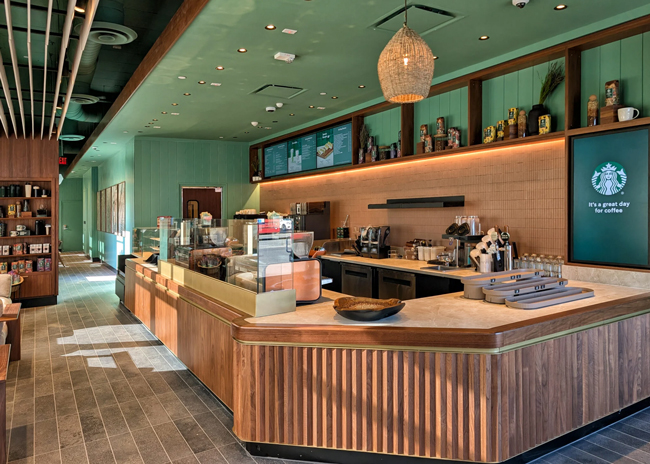 Image courtesy of Starbucks
Foodservice News
- Dirty sodas are cleaning up in the beverage business. In fact, dirty soda menu penetration is only at 2% but it’s growing at a rate of 42%, per MenuData shared by The Food Institute. What’s the draw of the dirty soda? For starters, dirty sodas are customizable, meaning consumers can craft their own. And they offer “an indulgent and exciting alternative,” the story adds.
- Wonder is shifting its identity from a restaurant with an app to an app with restaurants. The change reflects the company’s longtime desire to become a “super app for mealtime” that allows customers to choose food items from different restaurants all on one app. The transition includes a new logo, marketing campaign and more, per a Restaurant Business story.
- Raising Cane’s plans to fly across the big pond. The fast-growing, fast-casual chicken chain will open a flagship in London in late 2026, per a Nation’s Restaurant News story. It will also hire a president of Raising Cane’s U.K. and open a support center there. Raising Cane’s also plans to open several company-owned restaurants as part of its plans to lay a foundation in the U.K.
- Which state in the U.S. has the most fast-food restaurants? It depends on how you calculate it. If you are going by the number of quick-service restaurants per capita, then West Virigina is the winner with 50 fast-food joints per every 10,000 people, a Daily Meal story If you are looking for the state with the highest percentage of fast-food restaurants, then Maryland is the winner. Almost 47% of Maryland’s restaurants are of the fast-food variety, per data from a 2025 study by the Auguste Escoffier School of Culinary Arts quoted in the same piece.
- Pope Leo is bringing a taste of Chicago to a Vatican property. The Vatican selected Art Smith and Phil Stefani to develop the sole restaurant and serve as the exclusive catering services provider for its Borgo Laudato Si’, a historic papal retreat that has been newly opened to the public. These foodservice operations are slated to open next spring. The Borgo Laudato Si’ is situated within the historic Papal Villas of Castel Gandolfo, which have served as the summer residence for Popes since the 17th century. The menu will focus on “farm-to-table Italian cuisine, complemented by touches of global cuisine including Chicago and Peruvian influences.” Guests will also enjoy guided tours, a marketplace, and immersive ecological and cultural experiences amid one of Italy’s most historic estates.
- What’s next for Noodles & Company? The publicly traded fast-casual chain has initiated a “review of strategic alternatives in order to explore ways to maximize shareholder value,” per a release. Oftentimes, that verbiage is code that the company is looking for a buyer. In mid-August, Noodles & Company announced plans to close 32 underperforming locations by year’s end.
- Add Mexican chain Abuelo’s to the fast-growing list of restaurants filing for bankruptcy. The 26-year-old chain operates 16 restaurants across seven states. Not surprisingly, Abuelo’s cited inflation and changes in customer preferences as the main reasons for filing, per a FSR Magazine story.
Economic News
- “The Great American Jobs machine has stalled.” That was the reaction of one economist after seeing how much job growth slowed in August, per a CNN story. U.S. employers added just 22,000 jobs for the month, and the unemployment rate came in at 4.3%, its highest level since 2021, per data from the U.S. Bureau of Labor Statistics. Further darkening the data is a downward revision of the June report, which shows the economy lost 13,000 jobs that month. July’s job gains were revised upward to 79,000 from 73,000.
- Private sector employers added 54,000 jobs during August, per the ADP Jobs Report. This is less than the 75,000 jobs economists had projected, per a CNBC report and a far cry from the 106,000 jobs added in July. Disappointing private sector hiring is another indication of a cooling labor market. If there’s a silver lining in this report, it’s the fact that the leisure and hospitality sector added 50,000 positions, by far the most of any business segment the study tracks.
- The number of job openings totaled 7.2 million in July, per the Job Openings and Labor Turnover Survey released by the U.S. Bureau of Labor Statistics. This is down slightly from the 7.4 million reported in June, per the Associated Press. So far, the economy has been generating 85,000 jobs per month, which is down from 168,000 last year, the AP added.
- Orders for manufactured goods continued to decline in July, per data from the U.S. Census Bureau. Orders declined 1.3% compared to the previous month. And June saw orders decline 4.8%. Weakness among commercial aircraft orders (down 32.7% for the month) is the main culprit for the decline, per a Reuters report shared by Yahoo! Finance.
- Labor productivity increased 3.3% in the second quarter of 2025, the U.S. Bureau of Labor Statistics reported. Economists had projected a 2.4% increase for the quarter, per published reports. Output increased 4.4% and labor costs increased 1.0% during the quarter.
- Consumer credit increased 3.8% in July, per data from the U.S. Federal Reserve. Revolving credit, mainly credit card debt, increased 9.7%, while nonrevolving credit increased 1.8%.