Central Market Place at Oklahoma State University (OSU) offers a collection of diverse dining experiences to this Stillwater, Okla., campus with an enrollment of 18,930 undergrads and 4,740 graduate students. It replaces Kerr-Drummond Complex as the main dining operation on the west side of campus near residence halls.
“Kerr-Drummond was 65 years old and wasn’t meeting our needs for a dining facility that would appeal to students, faculty, staff and visitors,” says Vedda Hsu, director of University Dining Services. “This facility was operating in a building that had reached the end of its lifecycle. Its systems were outdated, inefficient and costly to maintain.”
Originally designed as a traditional residential dining space, the Kerr-Drummond complex had undergone multiple adaptations over time to accommodate a declining-balance meal plan program. These updates included adding various retail concepts such as a popular grab-and-go grocery, a deli, an Italian concept and a barbecue concept. As operations evolved, though, the facility became increasingly inefficient because of oversized kitchens with outdated equipment that minimized productivity, insufficient storage and poor product allocation. Kerr-Drummond may be repurposed in the future, though.
“Renovating the old building would have been much too expensive,” Hsu says. “We started the new Central Market Place project in 2019 before COVID-19. When the pandemic hit, the whole project was paused until 2021, and by then the budget for the project almost doubled. We had to shrink the size of our new project and stay on one floor versus the two floors we had anticipated. But we still have 10,000 more square feet than we did in Kerr-Drummond.”
Oklahoma State University Dining Services and Facilities Planning teamed up with KKT Architects and Bakergroup Foodservice Consulting & Design to develop a 31,000-square-foot dining facility. “This new operation allows OSU Dining to increase its kitchen capacity and offer a wider variety of food options to students and visitors on the west side of campus,” says Mona Milius, MBA, senior vice president, senior principal, Bakergroup Foodservice Consulting & Design, Grand Rapids, Mich. “The new building takes a modern twist on traditional architectural style that the OSU-Stillwater campus is known for, while creating a large-scale open interior where students and visitors alike can meet, dine, lounge and shop for grocery items.”
 Flush-mounted linear light fixtures visually guide students toward OSU’s food locker system. Overhead, ceiling baffles enhance acoustics. The wall graphic features a campus map and connects menu items with OSU streets. Photo courtesy of KKT Architects Inc., photo by Eric Baker Photography, Oklahoma City
Vision, Project Goals and Highlights
The project vision, project goals and final design address the evolving needs of the campus community. “There were challenges related to balancing flexibility with operational efficiency,” says Stephanie Occhipinti, LEED AP, vice president, production principal, Bakergroup. “The solution was to design spaces and systems that can adapt to varying student needs and traffic patterns, ensuring that the space remains functional and appealing under different circumstances.”
The design features spacious, airy layouts with ample room for circulation, ensuring that the facility doesn’t feel crowded even during peak times. Large windows bring in natural light, enhancing the open feel and creating a welcoming atmosphere. Exterior windows in both the dining areas and 1890 Market attract customers by showcasing people socializing and highlighting merchandise.
The design emphasizes diversity in dining offerings and a greater number of options on this side of campus, providing a wide range of food concepts, including 1890 Market, Byte with food pick-up lockers, The 405 Deli and Caribou Coffee.
These concepts support speed, accuracy and convenience. Byte allows customers to use a mobile app and kiosk ordering systems. “These systems also help reduce labor costs and collect valuable data to improve the offerings over time,” Hsu says. The other concepts use in-person ordering and mobile order options.
Central Market Place features flexible and scalable spaces, such as movable seating areas and multipurpose zones, allowing the space to easily accommodate everyday dining as well as functions, including events, meetings and summer conferences. The space features a mix of seating options, including small tables, booths, communal tables, smaller cozy nooks for intimate gatherings and comfortable lounge seats. Customers have access to outlets and charging stations.
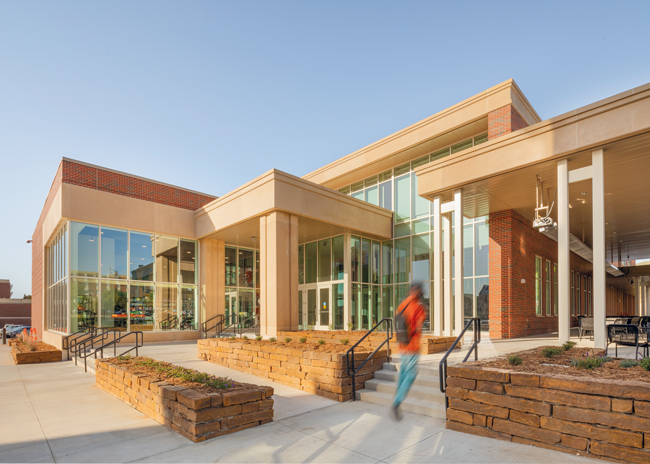 The exterior of the Central Market Place building at Oklahoma State University offers a modern interpretation of OSU’s modified Georgian style. Photo courtesy of KKT Architects Inc., photo by Eric Baker Photography, Oklahoma City
Floor Plan

Click here to download the floor plan equipment key.
Back-of-the-House Storage and Production
“The design of Central Market Place provides a clear, logical flow that allows for maximum efficiency, from the arrival of ingredients to the final delivery of food to customers, ensuring a smooth, continuous process that meets the needs of both staff and consumers,” Hsu says. “The layout is intentionally crafted to optimize labor usage by streamlining each step of the process, from the loading dock through to cold and hot production cooking lines, and ultimately to the guests.”
 The back kitchen contains prep tables, kettles, a griddle and a charbroiler. Photos by Abby HansenMost menu ingredients arrive at a raised, two-bay dock with two dock levelers and a ramp to assist with loading and unloading food and supplies. The receiving space houses a small workstation with a hand sink. Air curtains help keep pests from entering the building. The outdoor dock area includes space for parking spots for service vehicles, an in-ground grease interceptor, bulk carbon dioxide, a power wash station for cleaning carts and racks, a parking space for floor-cleaning machines, a battery-charging station, bins for trash, compost and recycling, storage for flatbed trucks, pallet jacks, milk crates, bread racks, bins for soiled linens and uniforms, and other miscellaneous items.
Staff take the ingredients through hallways to various storage areas, including walk-in coolers, freezers and dry storge. “We needed space for large trucks to bring in food and other products on rolling racks with shelves, and we didn’t want those making food deliveries to have to walk through the kitchen,” says Scott McCollum, assistant director, University Dining Services.
Storage areas are strategically divided between 1890 Market needs and those serving the rest of the kitchen. To maximize space efficiency, a high-density storage system helps maximize the usage of the floor space. Refrigerated and frozen 1890 Market products are directly stored in merchandising coolers and freezers, facilitating easy access and quick stock rotation for grab-and-go offerings.
Both Caribou Coffee and The 405 Deli have dedicated storage areas in those operations, ensuring that each concept has everything it needs within arm’s reach.
The kitchen contains a two-door reach-in refrigerator, a two-door reach-in freezer, a walk-in refrigerator/freezer combo, dry storage, cart storage and a blast chiller. The kitchen includes separate, designated workspaces for cold and hot food production. The cold production area contains three cold sandwich make tables, five prep tables, two food processors, a slicer, a 12-quart mixer, a 60-quart floor mixer, a microwave oven and an ice machine with bins. The staff make salads, which are packaged with the Good to Go self-branded logo and delivered to other dining units on campus.
Hot cooking equipment lines up along the perimeter walls to improve sightlines and supervision through the production area. Staff use a 40-gallon kettle, a 12-gallon steam-jacketed kettle and a 4-gallon steam-jacketed kettle to cook pasta, mashed potatoes, chicken stock, curries and shredded chicken. They also bake hot rolls, pizzas, proteins and some bakery menu items in two double-stacked combi ovens, and smoke pork and turkeys in a dedicated smoker. They also use a fryer for potato wedges, chicken patties and boneless wings, and bake pizzas in a conveyor oven. Burgers and other proteins are prepared on a 4-foot charbroiler, a 3-foot tilt skillet and a griddle-top range. Menu items keep warm in a four-well steam table, a heating warmer and two soup wells.
“The flow from preparation to production is carefully planned to support quick-service demands, particularly for mobile food orders offered through the lockers at Byte,” says Milius. “Ingredients for these orders are retrieved from bulk storage areas and placed in convenient locations within the kitchen, such as refrigerators, freezers and on prep tables, so they are easily accessible when orders come in. Orders are electronically transmitted to the kitchen, where they are printed, queued and prepared. Once ready, the orders are distributed to food lockers, where customers can easily pick up their meals.”
The back of the house also integrates a well-organized warewashing area for utensils, pans and storage containers. Dishwashing isn’t necessary because staff serve all menu items to customers on disposable ware. Strategically located adjacent to the kitchen, the warewashing area includes a designated queuing space for soiled dish carts and a clean side for accumulating washed utensils, pans and storage container. “This thoughtful arrangement minimizes congestion and ensures all areas of the operation are kept in top working condition,” says Occhipinti.
Staff use a conveyor potwasher, a three-compartment pot sink, other soak sinks, a silverware sorting table, drying racks, a disposer and utility carts. “Proper drainage, water-resistant wall surfaces and hose reels enable staff to thoroughly and efficiently clean the equipment and room,” Milius says. “Disposers were installed adjacent to the scrapping table in the dish room. In addition, a custodial closet with a mop sink and storage for cleaning supplies and products is located near the shared offices, with easy access to the dish room.”
 1890 Market, a convenience store, was named for the year OSU was founded.Photo courtesy of OSU Brand Management photography team
Front-of-the-House Branded Concepts
1890 Market, named for the year OSU was founded, is the university’s largest on-campus convenience store. Sarah Gould, AIA, A4LE, owner/CEO KKT Architects Inc., Tulsa, Okla., explains the design choices reflected in the space: “High ceilings, modern lighting, and custom graphics invite students into the 1890 Market, an on-campus grocery with an industrial aesthetic, featuring polished concrete floors for durability and ease of maintenance.”
Corrugated dark metal panels and custom signage highlight the entry to the store within the building, while clear sightlines reveal additional kiosks, the food locker kiosks, and a bright, accessible entry from the residential side of campus.
 High ceilings, modern lighting and custom graphics invite students into the 1890 Market, an on-campus grocery with an industrial aesthetic. Photo courtesy of KKT Architects Inc.; photo by Eric Baker PhotographyColor was strategically used throughout to support wayfinding and define individual service areas, while linear acoustic panels and lighting fixtures along the central axis bring cohesion to the space. Polished concrete floors add to the industrial aesthetic and offer a durable, low-maintenance surface ideal for high-traffic use.
“The market drives the majority of sales and activity within the building,” Hsu says. “This is a bustling hub of activity and a major draw, catering to a wide range of tastes and preferences while serving as a dynamic focal point of the space.”
The market, which was repurposed from the market in the Kerr-Drummond building, offers a wide variety of fresh, ready-to-eat grab-and-go menu items including salads, wraps, sandwiches, desserts, yogurt, snacks and grocery items. Grab-and-go menu items are wrapped with the internal branded logo Good to Go. Packaging contains a green label for customers on standard diets, a purple label for allergen-free menu items and an orange label for healthier menu items. Sushi is offered but is made at the Student Union kitchen daily and delivered to four campus locations. Other coolers contain juices, sparkling water, sodas and other beverages, milk, sour cream, quick-grab packaged items such as cheese and crackers, and grocery items such as chicken pot pies, hamburger patties and hot links. An open-air cooler holds fresh produce. “We will be purchasing produce from a student farm next fall,” Hsu says. “They now give to our nonprofit local food bank.”
A newly expanded cooler system, accessible from the back of the house, maximizes display space for fresh and healthy food options, supporting OSU’s commitment to student wellness. Storage space for 1890 Market was expanded and improved from the original. “These upgrades allow for more streamlined stock management, making it easier to maintain inventory levels and organize products for quick access,” Milius says. “This enhanced storage solution directly supports a better experience for staff and customers alike.” Customers check out from four cashiers.
Byte, an on-the-go concept in Central Market Place, uses a ghost kitchen concept located in the kitchen and offers 10 different rotating menu concepts. Customers place orders from an app on their mobile devices or kiosks residing nearby. “Payment is usually via a kiosk, but a cashier is available if the internet goes down,” McCollum says.
Staff in the ghost kitchen receive and prepare orders and then place them in one of 30 lockers. “This concept enhances customer convenience, offers flexibility and menu items they don’t get elsewhere on campus,” McCollum says. “With so many choices from
the 10 rotating concepts, customers feel they are receiving food from restaurants.”
Color codes around the lockers guide customers. Orange lights are always on, and when staff place food in the lockers, the light turns white. When customers come up and take out the food, the light turns green. Customers receive a receipt after placing orders online or from the kiosks with a QR code that opens the locker.
“Byte does between 500 to 700 transactions a day. This has exceeded our expectations,” McCollum says. “We thought we’d have to explain this to the students, but they figured it out, and the concept took off.”
 Kitchen staff prepare menu items for Byte lockers. Photo by Abby HansenByte’s rotating menu features: Dessert Bar (sweets), Green Spoon (vegetarian dishes), Legends (game-day classics); Linguetti’s (pizza by the slice and pasta); Lunch Byte (lunchtime classics); Mom’s Kitchen (homestyle cooking); Passport @ Night (favorites from Passport for Dinner); Roosters (wings and thighs); Salad Your Way (build-your-own salads); Taco Tempo (soft tacos); and Wrapped (build-your-own wraps). “Some of these menu items are replicated elsewhere on campus and due to their popularity are offered here at Byte,” McCollum says.
Whether or not to allow customers to see through the lockers to the prep kitchen behind stirred a debate among administrators and the design team. “We decided to keep transparency,” McCullum says. “I come from the restaurant industry, and I knew that we could keep the kitchen clean and relatively quiet. And we wanted customers to see how their food is prepared so they know it is fresh.”
“This innovative solution offers cost-effectiveness by reducing overhead and optimizing space, allowing for a variety of food options without the need for traditional dining areas,” Milius says. “Ghost kitchens also provide faster service, greater efficiency, and the ability to quickly adapt to student preferences and food trends. By focusing on delivery and takeout, they help reduce wait times and congestion while offering more sustainable dining options.”
The 405 Deli offers salads and 15 sandwiches made on bagels or other bread varieties such as white and jalapeno corn, rye, nine-grain wheat and gluten-free. All menu items are named for local Stillwater landmarks and streets and hotspots on campus. The name refers to Stillwater’s area code.
Sitting adjacent to The 405 Deli, dry storage includes three racks with four shelves on each and a double-door cooler. “We have a main cooler here so staff members don’t have to run to the coolers in the kitchen,” McCollum says. The deli area contains two impinger ovens to heat sandwiches, a display unit for sandwiches and salads, a bakery rack, two soup wells and a coffee brewer.
Caribou Coffee, an OSU-licensed coffee shop, is the second Caribou on campus. The other resides in the student union. “We’re the only franchisee in Oklahoma.”
The coffee shop contains three espresso machines, a nitro cold press machine, and a coffee brewer. The space also contains a bakery display for muffins, scones, donuts and bagels. In addition, Caribou also offers juice, fruit and yogurt smoothies, coolers with and without coffee, tea and oatmeal. In the back storage area, staff use shelving, a three-compartment sink and an ice machine.
In addition to the branded concepts, the Central Market Place building also partners with a student organization to set up a station where students donate canned food and personal hygiene products that are purchased from their unused declining balance meal plan at the end of the school year. The donations go to OSU campuses’ basic needs pantry and the Stillwater community pantry.
As OSU’s campus evolves, new opportunities for increasing service and more menu variety at Central Market Place will appear. The design and concepts offer staff flexibility to change menu items and keep up with the ever-changing menu trends on college campuses.
Looking back, Milius explains why the process resulted in a successful facility. “Throughout the process, the administrators and staff at the university played a crucial role in ensuring the success of the project. Their prompt responses and invaluable support throughout the programming phase were deeply appreciated and significantly contributed to the overall success of the planning process.”
Hsu agrees, adding that despite COVID-19 and budget cuts, the result is a successful operation unlike any other on OSU campus, which is also receiving attention from peers on other campuses. Customer participation in Central Market Place concepts have grown by 30% as measured by purchases students make at the dining concept compared to those at the previous facility.
 Students check their orders before picking up menu items from Byte lockers. Photo courtesy of OSU Brand Management photography team
About the Project
- Opened: September 2024
- Scope: Four branded concepts, a prep kitchen, open seating, covered patio seating
- Website: dining.okstate.edu
- Size: 31,000 sq. ft.
- Seats: 300, including indoor and outdoor
- Hours:
- 1890 Market: Mon. - Fri, 7 a.m. until 11 p.m.; Sat. - Sun., 10 a.m. until 11 p.m.
- Byte: Daily, 11 a.m. until 9 p.m.
- The 405 Deli: Mon. - Fri., 7:30 a.m. until 10 p.m.; Sat. - Sun. 10:30 a.m. until 10 p.m.
- Caribou Coffee: Mon. - Fri., 7:30 a.m. until 9 p.m.; Sun. 3 p.m. until 9 p.m.
- Average daily transactions:
- 1890 Market: 2,000
- Byte: 600
- The 405 Deli: 500
- Caribou Coffee: 250
- Average check:
- 1890 Market: $14.59
- Byte: $10.05
- The 405 Deli: $9.60
- Caribou Coffee: $7.05
- Menu concepts and specialties:
- 1890 Market: A convenience store offering groceries, grab-and-go menu items, snacks and necessities
- Byte: A ghost kitchen concept serving a rotating menu; menu items delivered through a locker-style system
- The 405 Deli: A self-branded sandwich concept offering gourmet sandwiches and salads named after Stillwater roads and locations
- Caribou Coffee: Specialty drinks and grab-and-go menu items
- Annual sales: $8.6 million
- Staff: 15 full-time; 99 part-time
- Total project cost: $22 million
Key Players
- Owner: Oklahoma State University
- Assistant vice president of student affairs: Tracie Brown
- University Dining Services (UDS) UDS director: Vedda Hsu
- UDS assistant director: Scott McCollum
- General manager of Central Market Place: Teresa Brown
- UDS marketing coordinator: Amanda Hamlett
- OSU long-range facilities planning: April Ebey, assistant director; Atticus Mullon, RA, assistant university architect/project manager
- Architect: KKT Architects Inc., Tulsa, Okla.: Sarah Gould, AIA, A4LE, owner/CEO; Francis Wilmore, AIA, LEED AP, principal, director of design; Kate Cofer, AIA, IIDA, COO; Aubree Hoover, AIA, LEED AP, CDT, CSI, senior associate; Dawn Nichols, principal, architecture
- Interior design: KKT Architects Inc. Tulsa, Okla.: Chris Champlin, LID, IIDA, senior associate; Cortlyn Birdsell, LID, IIDA, interior designer
- Structural engineering: KKT Architects Inc., Tulsa, Okla.: Jim Geurin, PE, SE, principal
- MEP consultant: Lee & Browne Consulting Engineers Inc., Tulsa, Okla.
- Civil consultant: CEC Corp., Oklahoma City, Okla.
- Foodservice consultants: Bakergroup Foodservice Consulting & Design, Grand Rapids, Mich.: James W. Sukenik, FCSI, president, design principal; Mona Milius, MBA, senior vice president, senior principal; Stephanie Occhipinti, LEED AP, vice president, production principal; Nona Golledge, marketing, design and operations, principal
- Equipment dealer: Amundsen Commercial Kitchens, Oklahoma City, Okla.: Dustin Mihelis, project manager
- Construction: Willowbrook Construction Co., Oklahoma City, Okla.