Students at Incline High School in Incline Village, Nev., now have opportunities to enhance their culinary arts studies in ways never before offered at this school.
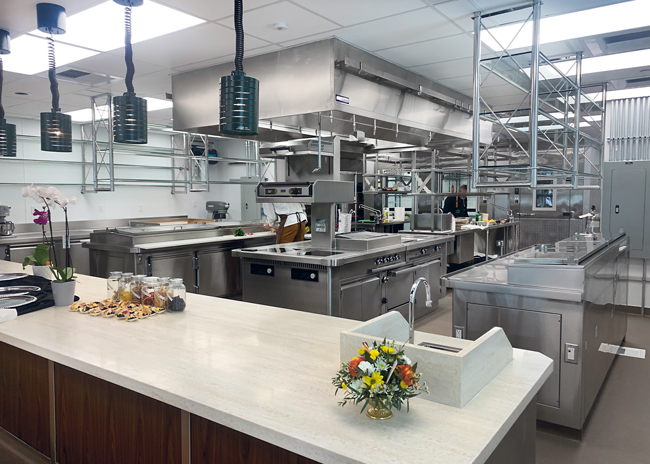 This is possible following a three-story expansion and interior remodel to this Washoe County School District high school that includes a state-of-the-art culinary arts studio with an event restaurant, Highlander Cafe, and commercial kitchen.
The project also includes security upgrades throughout the building for student well-being; a new single-point entry and administrative area; and remodeled classrooms, dance studio, ROTC classrooms and practice range and a modern student hub with mountain forest views.
The expansion and interior remodel project began in November 2022 following a scope and feasibility study on Incline High School conducted by Collaborative Design Studio, Reno, Nev. The study was commissioned by the Washoe County School District and the Dave and Cheryl Duffield Foundation for improvements to the existing high school building. As a result of the study and a donation by the foundation, the architects embarked on a design for a three-story expansion of the existing brick and concrete school.
Completed in the Spring of 2025, the addition emulates the existing, classic brick facade of the school with modern patterns and sweeping concrete gestures in the form of exterior balconies and walkways. The interior brings the school’s striking mountain setting — it is located in Incline Village, Lake Tahoe — into the building through the use of natural woods and tones of the forest inside the learning and gathering spaces of the new student hub. The building also contains sweeping expanses of glass and natural daylight that support student health and well-being. Light shelf and sun shading techniques around the full facade emphasize the use of natural light.
The expanded culinary arts program, with its teaching studio and full commercial kitchen, provides hands-on training in commercial food ordering and inventory, food preparation and production, advanced culinary techniques, nutrition, meal planning and food safety and handling. The program supports students earning industry certifications like ServSafe Food Handler. It also helps students build a foundation for a culinary career by providing them with real-world experience through preparing meals in the kitchen and serving guests participating in events in the Highlander Cafe dining room.
“The culinary program helps students develop creativity, discipline and life skills,” says Frank H. Müller, FCSI, principal, Müller Design Inc. “It gives them a head start on in-demand jobs with real-world experience and connects them directly to post-secondary education and careers in culinary arts. We believe this is one of only a handful of fully operational restaurant and dining facilities at a high school run by high school culinary students.”
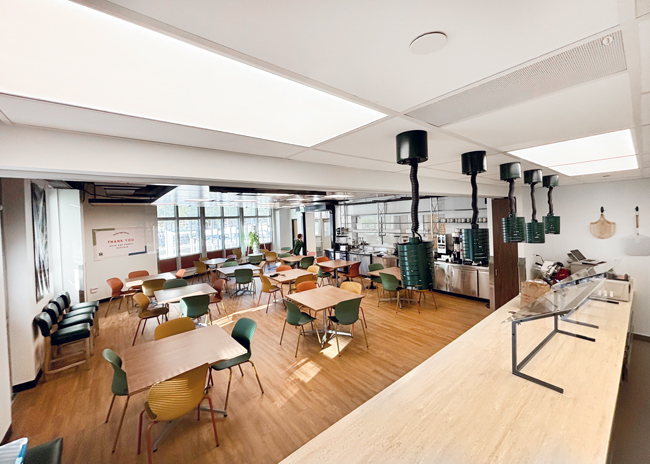 Guests at Highlander Cafe can watch culinary action as they dine. Photo by Neal Young
Müller Design Inc. created 3D virtual walkthrough movies that provide a frame-by-frame view of the new facility and serve as an immersive visualization tool for the high school.
“The kitchens and Highlander Cafe prepare students for the realities of high-end hospitality,” says Tierney Cahill, Incline High School principal. “Situated in a world-class resort community, students develop professional skills in an authentic environment, positioning them to succeed in premier destinations such as Incline Village, Aspen, Breckenridge, Truckee and Steamboat Springs. This is the role of modern education, creating authentic, real-world learning experiences that prepare students not just for graduation, but for successful careers.”
Heading the program, Neal Young, culinary chef/instructor, is thrilled to be teaching in the new facility. Young started with the school teaching English as well as Incline High School’s foods and nutrition classes, which took place in a small home economics room. He received a teaching endorsement for culinary arts when the state of Nevada decided such studies would all fall into culinary arts curricula. “I changed to teach full-time in culinary arts and was happy doing this in the home economics room. Then a donation came in to build a professional, commercial-style kitchen. I have to pinch myself to realize I have the opportunity to teach in this new kitchen.”
Young teaches six classes, including two introductory culinary arts classes, two medium-level culinary arts courses and two at an advanced level. Enrollment totals 86 students across all six classes. “Before, we had 20 students in a crowded room, and they didn’t have an immersive experience. Now, they all have hands-on training,” Young says. The class is so popular that almost every class is full.
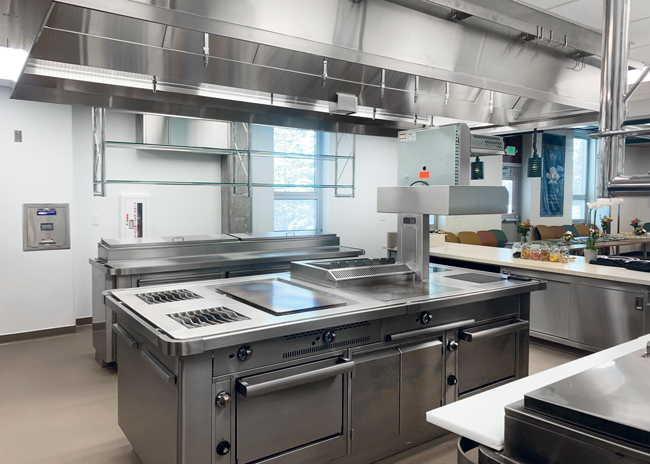 The cooking suite contains two open burners, two induction burners, a French top and a plancha. Photo by Sharon Ching
Deliveries and Production
Food deliveries arrive at the kitchen’s loading dock located on the same level. Students transport food to the kitchen and place it in a walk-in cooler, walk-in freezer and dry storage. In the cold-prep area, students prepare ingredients using a food processor, vegetable cutter and 5-quart and 20-quart mixers. Mixers also support the bakery/pastry station. Students work at custom designed and built remote refrigerated chef’s counters, which flank either side of the cooking suite.
Students bring mise en place and other cold ingredients to the island cooking suite. The custom-designed suite contains two burners, two induction burners, a French top for cooking sauces, soups and sauteing vegetables, a plancha for searing meats and other proteins and a charbroiler for grilling sausages, burgers and other cuts of meat. The suite also contains three convection ovens and a salamander broiler mounted on over-shelves for finishing menu items such as steak, nachos, grilled cheese sandwiches and French onion soup.
The kitchen also holds a multifunctional tilting skillet for students to boil pasta, deep-fry french fries and doughnuts and make fried rice and braised meats. It also contains two double-stacked combi ovens, one designated for bakery/pastries and the other one designated for food prep. Students use a double-stacked blast chiller to rapidly lower the temperature of hot food, moving it quickly through the bacterial danger zone of 140 degrees F to 40 degrees F to ensure food safety and maintain quality. Students mainly use the blast chiller for freezing produce, proofing bread and cooking cheesecake pop desserts. The blast chiller also rapid chills cooked foods such as soups, sauces and meats, shock-freezing them to prevent ice crystals, supporting low-temperature cooking and extending food shelf life.
A commercial vacuum sealer in conjunction with a food preservation system removes air from packaging, significantly extending the food’s shelf life, preventing freezer burn and reducing waste. This equipment securely seals liquids, soups, sauces, meats and bulk ingredients for storage, sous vide cooking, enhancing food safety and operational efficiency. “The food preservation system is an eco-friendly, reusable vacuum-packing system for commercial kitchens, featuring 99.8% vacuum-capable containers,” Müller says. “It enables storage, transport and marination in one pan, reducing food waste and plastic use. Key benefits include a two- to three-week food shelf-life extension and increased labor efficiency.”
All pieces of equipment were chosen for their versatility and ability to cook a variety of foods. “There is no set menu since this is a teaching facility,” Young states.
Students also learn about safe food production and sanitation. The kitchen contains a fully outfitted dishwashing and pot-washing area, complete with a door-type warewasher, clean and soiled dish tables, slant racks and a three-compartment sink.
The 52-seat dining room has an unobstructed view of the surrounding mountains and pine trees. It contains a full beverage service station including an espresso machine, satellite coffee brewers, coffee grinders, iced tea brewers, and an artisan water system with sparkling and still water on tap.
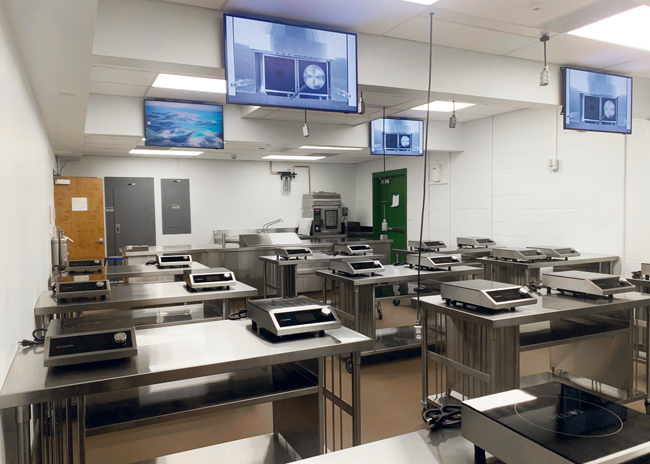 Students watch overhead monitors that mirror the instructor’s counter for visual learning.
Culinary Arts Classroom
The culinary arts classroom, located behind the commercial kitchen, contains 12 double stainless-steel workstations to accommodate a total of 24 students. Each mobile station is equipped with two induction burners with custom drawers to house the induction units when not in use, cutting board storage on either side and retractable electrical outlets for ease of use.
Students face the instructor’s counter where Young demonstrates cooking techniques. This is a versatile custom-built, ventless induction cooking station with a built-in hand sink and undercounter refrigerated drawers. The back counter contains a built-in prep sink and ventless combi oven. Students can see what Young is demonstrating by watching him directly and on monitors that hang overhead and mirror the instructor’s counter for visual learning.
During these classroom sessions, Young also teaches hospitality management and nutrition. Students will also learn how to greet customers, take orders and serve meals to guests at Highlander Cafe. Young invites local business owners and restaurateurs to come in and educate students about various facets of hospitality management. Guest chefs come to the school and share their own cooking tips and demonstrate how to create their own proprietary recipes and host cooking classes.
In its first year, the culinary arts program receives high marks from students, parents and the local community. “This is a dream-come-true facility,” Young says. “My one concern is that when students go out into the working world, they may not find such state-of-the-art equipment in such a nice space. However, they’ll have a strong culinary background, and I’m sure they’ll adjust to wherever they land.”
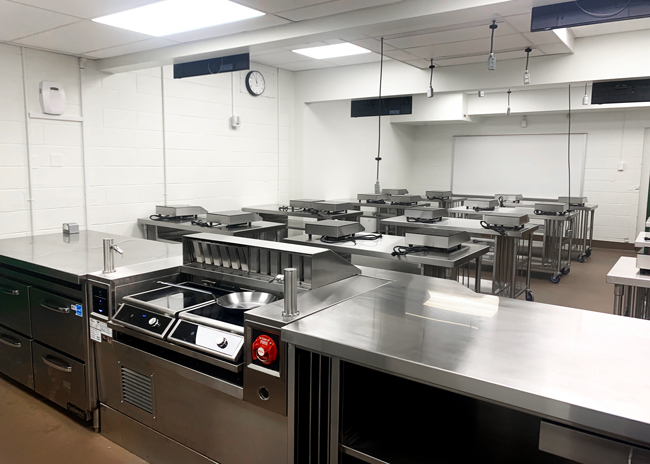 The instructor’s counter features a versatile custom-built ventless induction cooking station with a built-in hand sink and undercounter refrigerated drawers. Photos by Sharon Ching
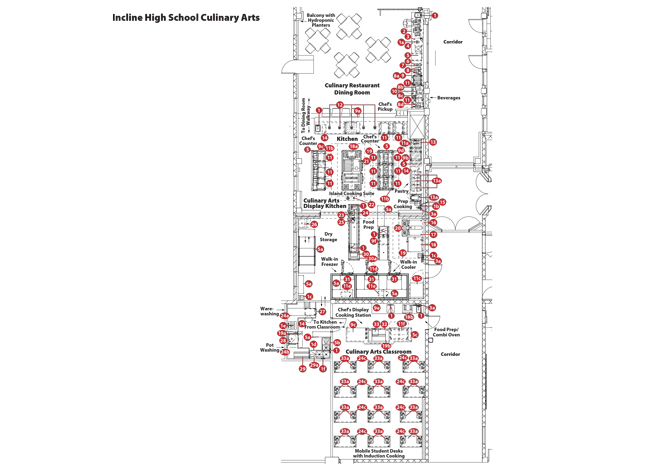
Floor Plan
About the Project
- Opened: March 4, 2025
- Scope of project: Expansion of culinary arts program with commercial kitchen, teaching kitchen, and a restaurant open to the public
- Website: inclinehs.washoeschools.net
- Size: 12,000 sq. ft.
- Kitchen: 1,288 sq. ft.
- Culinary classroom: 690 sq. ft.
- Dining room: 1,000 sq. ft.
- Seats: 52
- Menu concepts: Baked goods, soups, salads, sandwiches, entrees and desserts
- Staff: Culinary chef and 30 students
- Total project cost: $27 million
- Equipment investment: $1.3 million
Key Players
- Owner: Incline High School, Washoe County School District, Incline Village, Nev.
- Principal: Tierney Cahill
- Culinary chef/instructor: Neal Young
- Architect: Collaborative Design Studio, Reno, Nev.: Peter Grove, AIA, NCARB, principal; Seth Bartlett, AIA, NCARB, senior project architect
- Foodservice consultant: Müller Design Inc., Minden, Nev.: Frank H. Müller, FCSI, principal
- Equipment dealer: Boelter, Sacramento, Calif.
- Construction: Plenium Builders, Sparks, Nev.
- Financial support: Dave & Cheryl Duffield Foundation