New technologies and innovative products can keep any industry fresh.
And the healthcare foodservice industry is no exception. Healthcare facilities, both large and small, continue to embrace technological advancements in foodservice design, preparation, distribution and safety, while enhancing staffing efficiencies and managerial strategies. In doing so, they impact the health and well-being of their most important customers — the patients.
Like most industries, the healthcare foodservice segment faces labor shortages and a lack of skilled workers. As a result, foodservice operators at hospitals and other healthcare facilities continue to do more with less, oftentimes with less-experienced staff.
 Photos courtesy of JPS Health Network, JPS Communications“In this environment, retention becomes important — how are you keeping the staff you have?” asks Julie Meddles, MS, RDN, LD, director of health system nutrition services and gift shops at The Ohio State University Wexner Medical Center in Columbus, Ohio. “We have decreased total turnover, first-year turnover and improved vacancy rates significantly in the last five years. Some compensation practice changes have helped but we also formed a strategic talent and culture committee with many subcommittees focused on improving the staff experience.”
The Ohio State University Wexner Medical Center uses a software partner to train staff in bite-sized modules to get individual team members ramped up quickly and help maintain ongoing competence. Meddles says flexible staff models play an important role in managing labor. Examples include smarter scheduling, shorter shifts, part-time roles and, in some cases, shorter hours of operation. For example, some smaller off-site retail operations might close earlier and concentrate labor on core patient services.
“We use a centralized production kitchen to support all operations and deliver food to satellite sites to reduce redundancy and labor needs,” Meddles says. “We also have cross-functional roles, training staff to handle multiple duties to improve efficiency. And when needed, we’ve simplified menus requiring less prep and staff. At times, we choose prepackaged items versus made-from-scratch when it makes sense to save labor.”
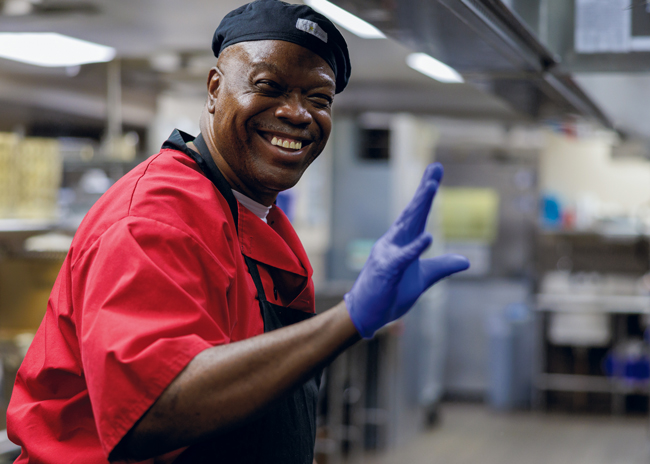
The JPS Nutritional Services team in Fort Worth, Texas, also focuses on efficiency, particularly in the production area. JPS produces more than 1.8 million meals annually from its main production kitchen, all within a small footprint.
“Our labor success stems from the skilled team members and leaders we’ve attracted,” says Neal Lavender, MHS, PHR, CDM, executive director of food and nutrition services at JPS Health Network. “Much of this is due to our hospital and nutrition leadership team. They play a crucial role in drawing in talented individuals who align with our mission.”
To maintain the high standards they’ve set, JPS Health Network has established comprehensive kitchen protocols and training expectations. These ensure that every meal consistently meets their established quality benchmark no matter who prepares it. The organization’s team members work closely with each new hire, providing hands-on training and support to bring them up to speed quickly and effectively.
“This commitment to training not only enhances the efficiency of our kitchen but also fosters a culture of teamwork and excellence,” Lavender says. “It also helps with retention, as our team knows what is expected of them.”
Staff make the majority of JPS Health Network’s offerings from scratch, but in a few areas, such as select desserts, soups or presliced produce, they incorporate convenience items. “These decisions are made to optimize efficiency in a high-volume environment and to ensure consistency and food safety, not as a compromise,” Lavender says. “Every item on our menu is selected with the patient experience in mind.”
This past year, JPS added self-ordering kiosks to its retail operations as part of a commitment to improving the customer experience. This was a significant advancement for JPS’ main cafeteria operations. These kiosks streamline service and reduce wait times, which allow guests to move more efficiently through the cafe. Importantly, JPS maintains a blend of cashier-assisted and kiosk options to meet different preferences and needs.
“Our cashiers continue to play a vital role in welcoming guests and supporting service, and this technology has allowed them to focus more on personalized interactions and customer support,” Lavender says. “Many customers have embraced the flexibility, and we’ve noticed a positive shift in engagement throughout the serving area.”
Technology Advancements
As the healthcare food service industry observes the rise of robotic technology, from autonomous carts transporting patient trays to robotic fryers, it’s clear that the foodservice landscape within healthcare is shifting dramatically.
JPS, for example, now uses more advanced cooking equipment like combi ovens, blast chillers and automated label makers. As Lavender explains, these innovations optimize workflows and consistency, freeing up the kitchen team to focus on food quality and better presentation.
 “This balance of advanced technology and traditional methods continues to enrich our kitchen operations,” Lavender says. “Although we do not have any robots in our operations at this time, we eagerly anticipate how continued robotic advancements will complement our operations in the future.”
For others in the healthcare foodservice space, technology — especially automation and robotics — is becoming a critical tool in helping healthcare foodservice operators manage labor shortages, improve efficiency and enhance the patient experience. Automating repetitive tasks frees up staff for more complex and patient-focused work. For example, The Ohio State University Wexner Medical Center uses autonomous mobile robots (AMRs) to do three primary things — move dishes, food and supplies to patient kitchens, move dirty dishes/meal trays from patient floors to the dish room and move trash out to the trash dock.
“We are leveraging software to decrease the number of touchpoints in patient dining — patients select meals on tablets — and we are currently updating our system so patients can select meals on their own device as well as through a smart TV,” Meddles says. “The digital meal ordering platforms link to patient health records. On-demand room service and bedside ordering platforms can also make meals feel more personalized and accessible. And we have mobile ordering apps for retail for ordering ahead — and will have mobile locker location for pickup of meals. We are also planning self-checkout in retail in the next year.”
More technological advances are entering the foodservice industry, and many of them will play an essential role in supporting evolving operational needs. Lavender says foodservice equipment is continuing to become simpler to use, with faster cooking times.
“We are also seeing an influx of new vendors rallying around the convenience food segment of the food industry. They couple specialized, smaller ovens or retherm equipment with their premade meal line,” Lavender says. “Robotics will also continue to enter the workplace to help manage the manual functions of foodservice operations. Self-ordering retail kiosks or ordering-ahead capabilities will become less expensive, more accessible and more widely used in healthcare.”
Lastly, Lavender says artificial intelligence (AI) will shape the industry, tracking data regarding customer trends, financial management, survey data mining and menu management, as well as website interaction. “It will define what is worth keeping and what is not worth our time to focus on,” Lavender says. “All of this is greatly needed as we anticipate what is next for our industry.”
Management Expectations
Management expects healthcare foodservice to contribute significantly to patient satisfaction, staff retention and an organization’s reputation and brand perception. At times, this means effectively managing competing priorities between efficiencies and financials to provide the highest touch service for patients.
“Cross-departmental collaboration is essential — operators need to work closely with nursing, IT, infection prevention, facilities, etc.,” Meddles says. “Operators also need to lead their business as a CEO of their space — maximizing retail and catering revenue, running efficient customer-focused operations and exploring new service models.”
Doing more with less is also a reality within the management of healthcare foodservice. This involves using data-driven decision making, quantifying performance with dashboards and key performance indicators and making evidence-based justifications for staffing needs, menu changes and equipment investments.
“With growth and expansion in our organization, we are constantly looking for ways to be more effective and innovative, while incorporating design-efficient methods of getting feedback from our customers to improve experiences,” Meddles says. “Operators are expected to champion innovation by researching, implementing and justifying technology investments, and we must speak the language of ROI and efficiency, not just culinary and service.”
Decentralizing food operations has become more of a trend in the last few years due to rising costs. As Lavender explains, there is an expectation for service, but operators need less
expensive solutions.
“These are less expensive to manage and provide a greater service scope for the operator,” Lavender says. “Foodservice leaders will need to continue to stay ahead of these industry trends and know how to implement them as subject-matter experts in the future.”
“In essence, management is asking us to make sure that the guest and patient are not only satisfied but [also] happy when they leave,” says Aatul Jain, executive chef at St. Peter’s University Hospital in New Brunswick, N.J. “Our healthcare centers are not only meeting but exceeding customer expectations in any reasonable way, which will help grow our business. That is and will always be management’s ‘go-to’ quest. In healthcare, once the patient has chosen a location, such as a hospital or long-term care facility, or even the doctor’s office, the only remaining thing that the patient can choose is the food the person is offered. So, it’s important to provide a positive culinary experience.”
Retail Innovations
Christine Guyott, executive principal at Rippe Associates, a Minneapolis-based consulting firm, says innovations in the retail avenue of the healthcare foodservice space still mirror those of other foodservice operations.
“Healthcare’s focus on culinary and serving healthy food that tastes good may not sound like an innovation, but you go into many hospitals, and their food is just as good, if not better, than the corporate or higher ed sector,” Guyott says. “Many healthcare chefs are known in their community for the advocacy and for their culinary skills — I think that is a huge step forward for healthcare, and I’m proud at how far that has come for advancing our industry and the perception of food.”
 Healthcare and food and nutrition teams in general have also gone from being called “dietary” to “culinary,” which is a shift that shows the importance of the players and their influence.
“They are culinary and wellness specialists together serving both patients, staff and families. The menu items I see posted online as well as in person rival any local restaurants, and they get their inspiration from other healthcare chefs,” Guyott says. “They learn from each other and have created dishes that delight their customers and are a part of their healing journey — not just sustenance while they are in the hospital setting.”
As healthcare foodservice operators take on more strategic roles, moving beyond traditional meal service to contribute to patient recovery, operational efficiency and sustainability efforts, retail foodservice concepts continue to evolve.
To enhance St. Peter’s retail food service concepts, Jain reviews emerging consumer trends from publications and reports, technological advancements, information provided by manufacturers and vendors and sustainability initiatives discussed in web, print, social media and from government agencies and other nonprofits.
“Some key ideas of retail inspiration include embracing innovative foodservice models like AI-driven ordering systems and automated food prep,” Jain says. “Healthcare foodservice systems also are focusing on immersive dining experiences that cannot be replicated at home, such as personalized meal options, which are extensively being used now as ‘food is medicine,’ AI-powered analytics, IoT-enabled kitchen monitoring and digital ordering platforms all help optimize efficiency and enhance customer engagement and experience.”
JPS Nutritional Services recently moved into smart vending as part of their retail foodservice strategy and believe that is their future. Of course, with any new project where capital is required, there is always an expectation of a positive ROI.
“We can now offer good-quality food products around the clock for our customers. With each smart vending machine, we’re crafting a new era of foodservice that prioritizes accessibility, satisfaction and innovation,” Lavender says. “We are already showing positive returns on this new endeavor. This new technology also uses an app to help market services and drive sales. We see this advancement shaping the food service world, specifically as an on-the-go solution.”
Forward Thinking
With hospitals getting larger and systems growing, the foodservice departments within those entities need to respond with as much systemization and standardization as possible. That’s why many healthcare foodservice professionals expect technology to continue to play a key role in their operations. Meddles points to the need for automated tray lines for meal assembly, which reduce dietary errors and allow fewer people to efficiently produce more trays with greater accuracy. She expects a continued expansion of smart vending, micromarkets and self-checkout stations, all of which maintain service access with fewer staff, especially during nights or weekends.
“We have a robotic barista but expect more robotic options to automate workflows — maybe like the robotic arms that make salad or pizzas or something like that. Maybe more hospitals will have full fleets of AMRs [autonomous mobile robots] doing key delivery and pickup functions,” Meddles says.
There will also be more AI-driven functions like forecasting meal volumes, adjusting prep levels, predicting patient activity, optimizing staffing needs, ensuring quality controls, monitoring temperature, and enhancing AI-driven patient education, menus and nutrition coaches.
“Patient satisfaction remains paramount at the core of all we do. This will continue to be the expectation, even as we navigate rising costs and labor challenges,” Lavender says. “Prioritizing nourishing meal services is essential for healing and comfort. By creatively managing food costs and waste, we can enhance our offerings without compromising quality.”
Tapping in on Senior Living
 Robert J. Darrah, CDM, CFPP, CHC
Director of Dining Operations
Lincoln, Neb.
Q: What is on your bucket list lately for Legacy Retirement Communities?
A: One thing high on my list is expanding more customized dining options for residents — giving them flexibility not just in what they eat, but how and when. We’ve come a long way from set mealtimes and limited choices.
I’d love to continue developing micro-dining experiences within our communities — whether it’s themed pop-up dinners, chef’s tastings, or grab-and-go markets. It’s about giving our residents the same culinary freedom they’d enjoy outside of senior living. Recently we’ve opened pubs at each of our communities offering a lighter fare along with full bar service.
Q: Has food become more important over the years?
A: Absolutely — food is a major driver of satisfaction in senior living. It’s not just about nutrition, it’s about dignity, pleasure, and social connection. When families read glowing reviews, they’re often about the food experience: “My dad loves the meals,” or “Mom looks forward to dinner with her friends.”
Over the years, expectations have risen — rightfully so. Today’s residents are more discerning, and they’ve eaten well their whole lives. We’ve embraced that challenge and made food a central part of what makes Legacy feel like home.
Q: How has your farm-to-table approach evolved over the years?
A: Early on, “farm-to-table” was more of a buzzword. Over time, it’s become a guiding philosophy for us. We’ve built genuine relationships with local farmers and producers, which not only gives our residents access to fresh, seasonal ingredients, but also supports our community. Now, it’s less about trend and more about trust, transparency, and flavor. Residents taste the difference — and they care about where their food comes from.
Q: Where are you turning for inspiration for retail concepts as amenities?
A: We look at everything — from boutique hotels to college campuses, cruise lines to airports. Anywhere people are living, moving, and eating on the go, we can learn something. But we always bring it back to the resident experience: What adds value to their day? What makes life easier or more enjoyable? That’s why we’re experimenting with spaces like coffee shops, hybrid gift-and-snack shops — retail that’s convenient but also feels special.
Q: Like most segments, senior living operators generally do not have enough labor and are being asked to do more with a smaller team. How are you adapting?
A: It’s definitely a challenge across the industry, and we’re feeling it too. We’ve had to become more strategic — not just about staffing numbers, but about workflow and where we place our talent.
We’ve consolidated some back-of-house operations to improve efficiency and reduce redundancy, and we’ve invested in cross-training so team members can flex into different roles as needed. Smaller kitchen footprints in some new builds or renovations are helping too, especially when paired with smarter design and equipment.
Technology has also become a huge part of the solution. We’re using digital ordering systems, inventory management tools, and forecasting to help our team work smarter. But tech alone isn’t enough — we’re also focused on culture. Retention has become just as important as recruitment.
Q: How has what management asks of you changed in the past three to five years?
A: Over the past few years, my role has grown far beyond just food quality and kitchen operations. Management is looking for dining to drive broader value — resident satisfaction, brand reputation, and even revenue generation. There’s a much greater emphasis now on dining as a strategic pillar of the community experience, not just a necessity.
We’re expected to be more data-driven, more efficient, and more creative. That means finding smart ways to deliver high-quality meals while managing food and labor costs tightly. The expectation for ROI is real—whether it’s from retail operations, catered events, or new amenities like cafes and grab-and-go markets. Everything has to contribute either to resident satisfaction, operational efficiency, or revenue potential — and ideally all three.
Q: What will expectations be like moving forward?
A: Looking ahead, I think expectations will continue to evolve toward greater integration with hospitality and wellness. Dining has to align with lifestyle, health goals, and the overall resident experience. And retail is going to be a bigger part of that, offering flexibility, personalization, and convenience — all while reinforcing a sense of choice and independence for our residents.