Servery designs have evolved, with increased efficiency, faster service and enhanced merchandising capabilities.
Years ago, servery designs focused mainly on speed of service with minimal creativity in design. Over the years, this has changed. Today, these operations feature open areas that pay more attention to traffic patterns for speed of service. Branding has also become front and center with multifunctional stations that accommodate different dayparts.
A servery design’s main purpose is disbursing guests into different areas, says Ken Schwartz, president and CEO, SSA Foodservice Design + Consulting, based in Tampa, Fla. “It’s about promoting products being offered with signage, attractive finishes and appealing displays.”
The area also must be easy to navigate with queuing that doesn’t create bottlenecks. Fast and efficient service is key. “People walking in should immediately see all the options, rather than wandering around aimlessly,” says Linda Callahan, studio director at Next Step Design, headquartered in Annapolis, Md. “Also, everything in the back of house should be well thought-out, from delivery to execution [to help support all front-of-house stations].”
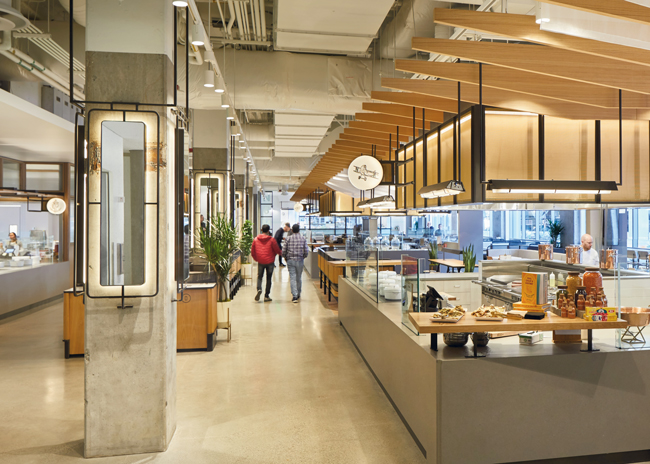 This corporate facility’s servery design features cohesive station branding and upscale touches. Photo courtesy of Next Step Design
Initial Considerations
Begin by understanding the clientele a servery will cater to. For example, feeding students at a school will differ from feeding employees at a corporate dining operation. Not only will the customers’ approaches to dining differ, but they will also have different time constraints. “We have to look at who we are serving and when we are serving them,” Schwartz says. “We determine if there are designated operating time slots with closures in between or continuous service with all dayparts into late night [such as with a university].”
Then, the servery design should take into account menu and production details. Pizza represents a fairly ubiquitous menu item that has multiple ways of preparation. For example, the operation could choose to create the pizza completely from scratch, use premade dough, or use dough that is pre-prepared and baked from a fresh or frozen state.
So, understanding where prep will occur figures prominently into servery design. A salad bar could include precut produce or utilize produce prepped in-house. “With serveries, certain items can either be prepared in the back or front of house,” Schwartz notes. “This paints a picture that drives the design.” The number and types of food areas will also figure prominently in developing a servery’s design.
When designing the back of the house that supports a servery, start by developing an understanding of the flow of goods from receiving to point of service. “We need to see the loading dock flow, the path of travel with food as well as the points of service, and how soiled dishes and trash go to the back of house,” Callahan says. “If the campus or commissary is larger, we consider how the servery may be supporting other points of foodservice.”
The design should also take into consideration staff crossover or when two people have similar tasks and must utilize the same space, adds Chef John Rifkin, vice president of culinary experience, education, Elior. “It’s all about efficiency and productivity, so there’s not duplication of efforts,” he says. “The rule of thumb is to design each workspace in a triangle with limited steps required.”
Front-of-the-House Feel
Calculating how much space a servery requires can be a complex exercise. Start by determining how long a guest will be at each station. “It’s important to look at how long orders will take to make,” Schwartz explains. “Pizza may be a quicker transaction than the grill or deli counter, so it’s important that slower stations are off to the periphery to avoid bottlenecks. Counter placement should also be strategic so throughput isn’t pinched.”
In the past, servery design took on a cooler, more institutional feel. That’s no longer the case, according to Schwartz. Instead, today’s servery designs aim to promote warmth and hospitality while bustling with energy that attracts diners. “Although there is separation between the front and back of house with stations like dishwashing, prep and cold holding, much of the action stations migrate to the front of house,” he adds.
This is due to the most critical consideration with these designs, which is delivering a high-quality brand experience, Rifkin adds. “Whether designing a taco or Mediterranean station, it’s about expectations,” he says. “We look at what guests see and don’t see, building walls when necessary to segregate areas.”
In addition to branding, volume and throughput play an important part in the overall design. Like with any foodservice operation, it’s important that the delivery meets customer expectations.
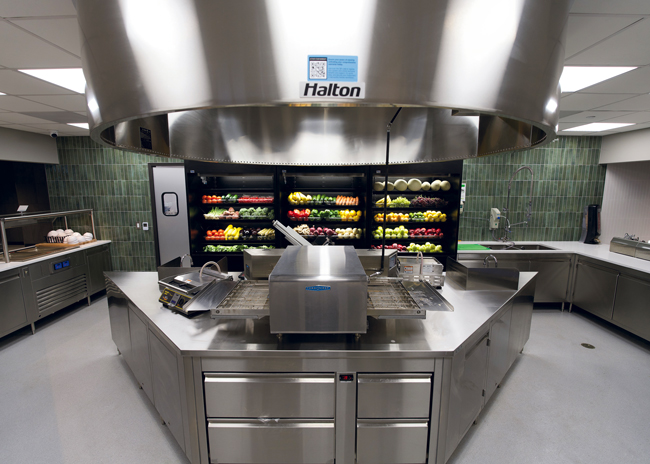 Fresh produce and a conveyor oven are the centerpieces in this servery. Photo by Kyle Barber
Essential Equipment
Servery designs can benefit from the latest equipment technology. Rifkin notes that one of the biggest enhancements to these designs is the addition of rapid-cook technology. “A couple of Frostburg’s [State University in Frostburg, Md.] servery concepts are on rotation, so we need to be able to move equipment in and out for the next brand or concept,” he says. “Rapid-cook ovens [are easy to relocate and] cook a variety of items at the same time at different temperatures.”
By the same token, hot and cold wells allow for increased menu flexibility. “With this equipment, we can have a pasta bar on one side and a salad bar on the other,” says Michelle Houston, resident district manager for Elior. “This allows for lunch and dinner flexibility.”
Combi ovens represent another game-changing server technology. While these units can be costly, they may also save money in the long run. “Combi ovens offer increased yields compared to convection ovens, so they pay for themselves over time,” Schwartz says. “We also often include custom food guards that are in line with the interior design as well as the look and feel of the operation.”
In addition, with a continued focus on sustainability, many university and business and industry serveries are incorporating green initiatives into designs. “In the last couple years, we’ve seen great advances in electric equipment, such as pizza and tandoor ovens,” Callahan says.
As older buffet-style, straight-line serveries with no definition are replaced with creative, open and brand-intensive designs, it’s easier to create spaces that add to the overall customer experience. Rifkin says that servery designs don’t get enough credit when it comes to the finished product. “We look at the beginning of production in the back of house and how that dish gets to the second and final third phase of completion,” he says. “A thoughtful design ensures that the finished dish is consistent every time.”
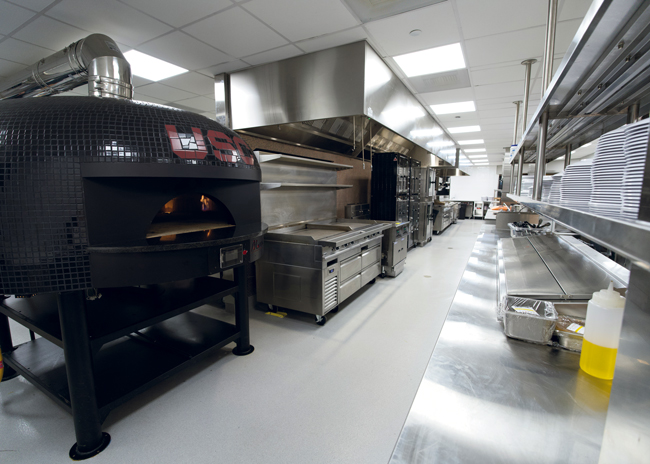 The back of house is visible in this servery, which is designed to highlight the dome oven. Photo by Kyle Barber
Frostburg State University
When Elior partnered with Fabio Viviani Hospitality to create a new servery at Frostburg State University in Frostburg, Md., research was first conducted to determine what concepts resonated in this collegiate environment.
“We worked with SCOPOS Hospitality Group to look at labor and food cost models, hours of operation, volume and dayparts, then selected equipment with menu design in mind to streamline service,” says chef John Rifkin, vice president of culinary experience, education, Elior. “We made decisions based on speed of service so chose fast and modern equipment to best move students through the servery during rush periods.”
The project team for Frostburg State then confirmed the square footage available and assessed existing equipment that would be carried over. This helped map out each space for different concepts.
Waynesburg University
Before its extensive renovation, the main servery stations at Waynesburg University in Waynesburg, Pa., included an old conveyor pizza oven on one side and a salad bar with two soup wells on the other. Separated by a wall, these areas were not cohesive.
“The goal of the new space included an open concept with [action stations] in the front of house and more visibility of fresh ingredients [being incorporated in dishes],” says Michelle Houston, resident district manager for Elior, which is Waynesburg’s contract foodservice operator.
This design approach drives home a servery’s function of highlighting the many offerings. “At Waynesburg, the servery accommodates 410 for lunch and 380 for dinner, but it’s spread out differently due to student schedules,” Houston says. “For instance, unlike at dinner [where traffic is more spread out over time], the lunch crowd comes in all at once. This meant we had to ensure both flows work within the space.”
This was a factor when determining the equipment package. For example, Waynesburg University’s hood is oversize to accommodate a smoker for cooking pork butt, baby back ribs and deli meats; two plancha grills for different dayparts; and a six-burner range with an oven for items like omelets in the morning and pasta in the afternoon.
The Waynesburg servery also incorporates hot and cold wells to reduce the number of trips staff make to the back of the house to fetch ingredients. “The large pizza oven was replaced by four speed ovens for producing personal pan pizzas in under three minutes,” Houston adds.
“We need to make sure all the necessary equipment can be housed, and this can be tricky with older schools and utilities,” Houston says. “We also look at what the program needs to deliver to the students and make sure what we’re trying to achieve can happen.”